

Winter is such an underrated season for hands-on learning. When kids are bundled up, stuck indoors more often, and full of questions about snow, ice, and cold weather, it’s the perfect time to lean into winter STEM activities. Science, technology, engineering, and math don’t need worksheets or complicated setups — they thrive when kids get to touch, test, observe, and talk about what’s happening.
These winter STEM activities are especially great for supporting early learning skills like observation, vocabulary development, and problem-solving. When kids describe what they see, explain what changed, or predict what might happen next, they’re building language and reasoning skills right alongside science concepts.
Each activity below includes materials and clear step-by-step instructions so you can confidently set it up at home, in a classroom, or even outside if weather allows.
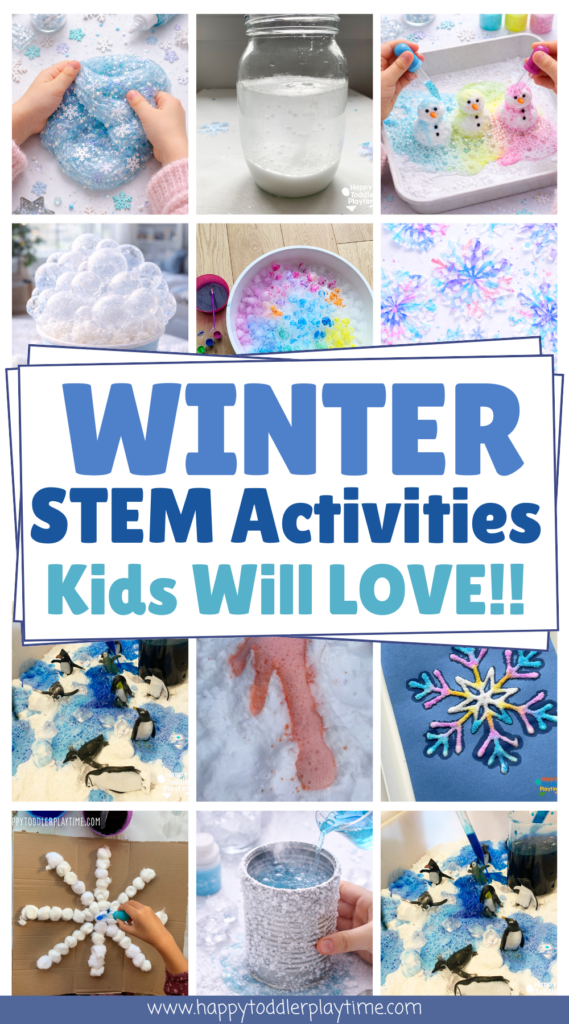
Easy Winter STEM Activities for Kids
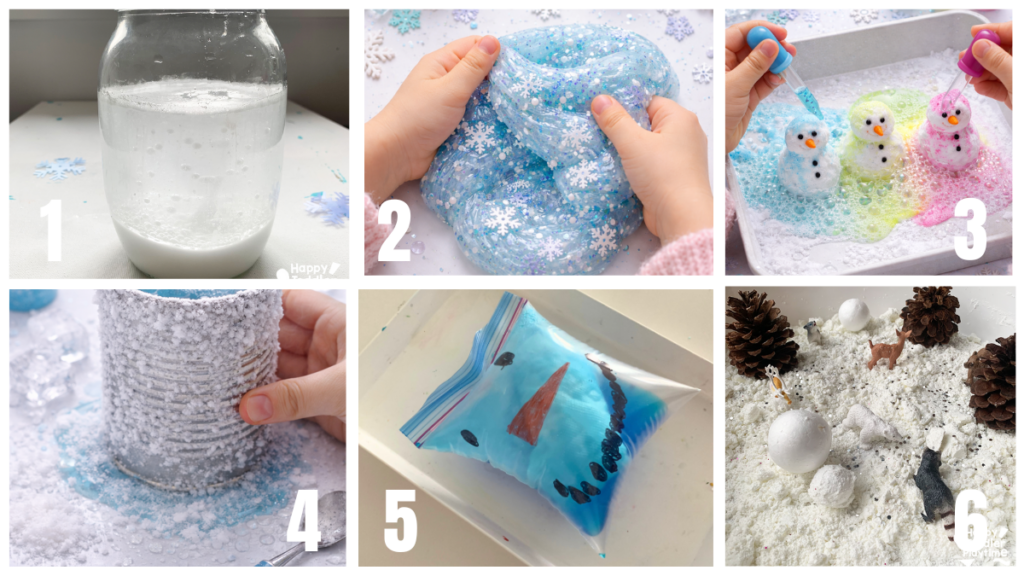
1. Blizzard in a Jar
Materials
- A clear jar or glass
- A spoon or craft stick
- A bowl to mix white paint and water
- White paint (for that snowy blizzard effect)
- Baby oil
- Alka-Seltzer tablets, broken into quarters
Instructions
In a bowl, mix a small amount of white paint with water until well combined. This will be your snowstorm mixture. Fill your jar about three-quarters full with baby oil. Then, slowly pour the paint-water mixture on top. Watch as it settles to the bottom, creating two distinct layers! Drop a quarter piece of Alka-Seltzer into the jar and watch the blizzard come to life! The tablet will sink to the bottom and start reacting, creating a mesmerizing blizzard effect. Add the tablets one at a time to keep the storm going!
2. Snowflake Slime
Materials
- 1 cup white school glue
- ½ teaspoon baking soda
- 1 tablespoon contact lens solution
- Silver glitter or snowflake confetti
Instructions
Pour glue into a bowl and stir in baking soda. Add glitter and mix well. Slowly add contact lens solution while stirring until slime begins to pull away from the bowl. Knead with hands until smooth. Encourage kids to stretch, pull, and squish the slime while discussing texture and elasticity. Store in an airtight container.
3. Fizzy Snowman
Materials
- Baking soda
- Water
- Vinegar
- Food coloring
- Tray
- Eye droppers
Instructions
Mix baking soda with small amounts of water until it forms a moldable dough. Shape into snowmen directly on a tray. Mix vinegar with food coloring in small cups. Using droppers, drip vinegar onto the snowmen and observe the fizzing reaction. Rebuild and repeat as desired.
4. How to Make Frost
Materials
- Empty metal can (clean and dry)
- Ice cubes
- Rock salt or table salt
- Spoon
Instructions
Start by placing the metal can on a tray or in a sink to catch any dripping water. Fill the can about halfway with ice cubes. Sprinkle a generous amount of salt over the ice — this step is key and should not be skipped. Using a spoon, stir the ice and salt together for about one minute. As you stir, encourage kids to look closely at the outside of the can.
Within moments, frost will begin forming on the outside surface of the metal. Pause and observe together. Feel the can carefully with fingertips and notice how cold it becomes. Talk about how salt lowers the freezing point of ice, causing it to melt faster while pulling heat from the surrounding air. This heat transfer is what creates frost on the outside of the can. Repeat the experiment to see if more salt creates more frost.
5. Exploding Snowman
Materials
- Ziplock Bag
- Paper Towel
- Babking soda
- Vinegar
- Sharpie
- Blue food coloring
Instructions
Decorate outside of ziplock bag as a snowman. Place a tablespoon of baking soda inside the paper towel and fold it into a small package. Fill the bag with vinegar and place the paper towel packet into the bag and seal. Place on a tray. As the vinegar soaks the paper towel it will start the reaction and the bag with begin to expand and then explode.
6. Fake Snow
Materials
- Baking soda
- Shaving cream
- Large bowl or sensory bin
- Spoon or hands
Instructions
Pour baking soda into a large bowl or sensory bin. Slowly add shaving cream a little at a time, mixing as you go, until the texture looks fluffy and snow-like. The amount of shaving cream needed will vary, so encourage kids to observe and adjust. Once mixed, invite kids to squeeze, scoop, and shape the fake snow into snowballs, mounds, or simple sculptures.
As kids play, talk about texture and consistency. Ask questions like, “What happens if we add more baking soda?” or “Does it feel more like snow when it’s dry or wet?” This activity is great for sensory exploration while introducing the idea of mixtures and cause-and-effect.
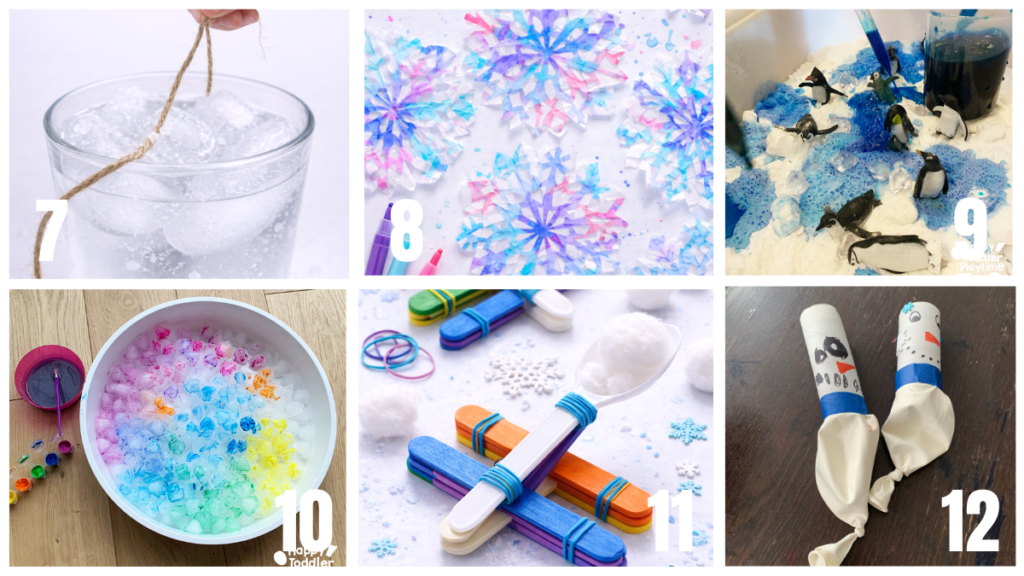
7. Ice Fishing
Materials
- Small cup or bowl
- Glass of water
- String or yarn
- Popsicle stick
- Salt
Instructions
Fill the cup with ice cubes and water. The cubes will bob up and down in the water and then float on the top. Place one end of the string on top of the ice cube and sprinkle salt on the ice where the string is touching. Watch as the water melts slightly and refreezes. After about 20 seconds, carefully lift the ice cube out of the water with the string. You’ve caught an ice fish.
8. Coffee Filter Snowflakes
Materials
- White coffee filters
- Washable markers
- Spray bottle with water
- Tray
- Scissors
- Flat surface
Instructions
Start by flattening a coffee filter. Color with washable markers. Spray with water to spread out the color and allow them to dry. Then fold it in half, and then in half again (or more, depending on your child’s skill level). Demonstrate how small snips along the edges will change the final design. Let kids carefully cut shapes, curves, and triangles along the folded edges. Once unfolded, examine the snowflake together. Talk about symmetry and patterns — point out how shapes repeat on each side. This activity is an easy way to introduce early math and geometry concepts while strengthening fine motor skills.
9. Fizzy Penguins Sensory Bin
Materials
- Baking soda penguin shapes (made with molds or by hand)
- Vinegar
- Sensory bin or tray
- Eye droppers or small spoons
- Optional: blue food coloring
Instructions
Fill sensory bin with baking soda. Place penguins in baking soda. Mix vinegar with a few drops of blue food coloring for a wintery effect. Invite kids to use droppers or spoons to slowly pour vinegar over the penguins. Encourage them to watch closely as the fizzing starts. Ask questions like, “What part is fizzing first?” or “What happens if we add more vinegar?” This activity blends sensory play with basic chemistry and supports language development through observation and description.
10. Ice Painting
Materials
- Ice cube tray
- Liquid watercolors or food coloring
- Thick paper or cardstock
- Tray or baking sheet
Instructions
Fill a sensory bin with ice cubes. Invite kids to using paints or water colors to paint the ice.
11. Snowball Catapult
Materials
- Craft sticks
- Rubber bands
- Plastic spoon (optional)
- Snowballs, cotton balls, or pom poms
- Measuring tape or ruler
Instructions
Help kids build a simple catapult using stacked craft sticks secured with rubber bands. Add a spoon to the top if desired. Place a “snowball” in the launcher and experiment with pulling back different amounts before releasing. Encourage kids to predict how far the snowball will travel, then measure the distance. Repeat and compare results. This activity introduces engineering, force, and measurement in a hands-on, playful way.
12. Snowball Launcher (Balloon Launcher)
Materials
- Toilet Paper Roll
- Balloon
- Tape
- Snowballs, cotton balls, or pom poms
Instructions
Cut top off a balloon and tie the bottom into a knot. Stretch the balloon opening over one end of a toilet paper tube end and secure with tape. Drop a snowball into the other end of the roll, pull the balloon back, and release. Invite kids to experiment with how far the snowball travels based on how far they pull the balloon. Discuss tension, stored energy, and motion. This activity works well indoors and encourages trial-and-error learning.
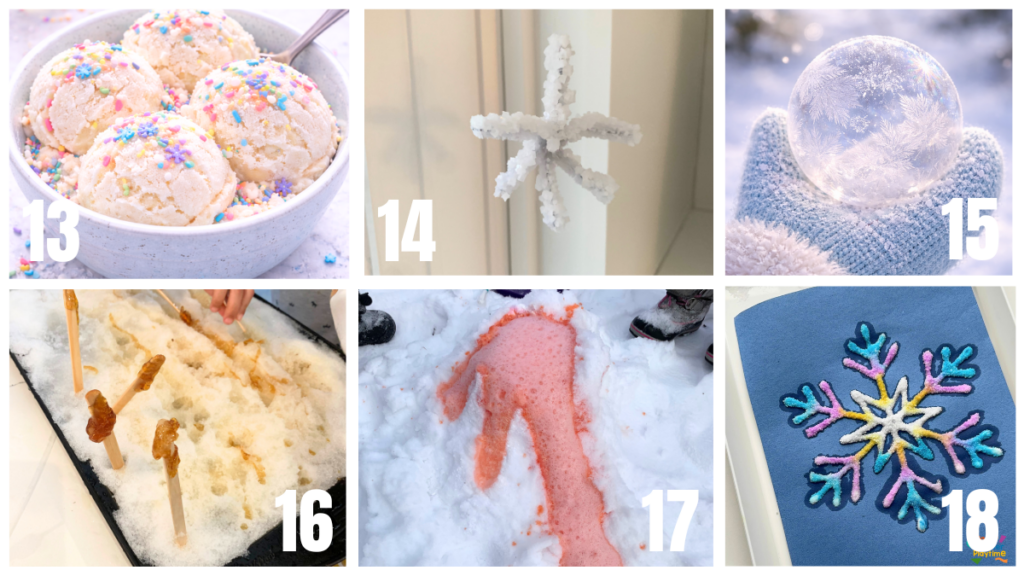
13. Snow Ice Cream
Materials
- Clean, freshly fallen snow
- 1 cup milk or cream
- 2 tablespoons sugar
- ½ teaspoon vanilla extract
- Large bowl
- Spoon
Instructions
Start by collecting fresh, clean snow from an untouched area, away from roads, pets, or foot traffic. Lightly pack the snow into a large bowl, but don’t compress it too much—this helps keep the texture light. Pour milk or cream over the snow, then add sugar and vanilla. Stir slowly until the mixture thickens into a soft, scoopable consistency.
14. Salt Crystal Snowflake
Materials
- Pipe cleaners
- Salt
- Hot water (adult help)
- Glass jar or cup
- Spoon
- String and pencil (optional)
Instructions
Bend pipe cleaners into snowflake shapes by twisting several pieces together and forming arms. In a separate jar, carefully pour hot water and stir in salt until no more dissolves—this creates a saturated solution. Suspend the pipe cleaner snowflake in the jar using string and a pencil, making sure it doesn’t touch the sides or bottom. Leave the jar undisturbed overnight. The next day, remove the snowflake and observe the crystal growth. Talk about evaporation and how salt leaves the water and attaches to the pipe cleaner as crystals. This activity is perfect for practicing patience and making predictions.
15. Frozen Bubbles
Materials
- Bubble solution
- Bubble wand
- Outdoor freezing temperatures
Instructions
On a very cold day, head outside with bubble solution and blow bubbles slowly. Encourage kids to watch closely as bubbles land and freeze, forming delicate patterns and textures. Some bubbles may crack or collapse, which is part of the learning process. Ask kids what they notice about the bubbles compared to warm-weather bubbles. Talk about temperature, freezing points, and how cold air changes the behavior of liquids. This activity is simple but powerful for visual observation and scientific discussion.
16. Maple Snow Candy
Materials
- Pure maple syrup
- Saucepan
- Clean packed snow
- Spoon
Instructions
Heat pure maple syrup in a saucepan until it reaches a gentle boil (adult step). Pack clean snow tightly into a shallow pan or bowl. Carefully drizzle the hot syrup over the snow in thin lines and watch as it instantly hardens. Discuss how temperature affects liquids and why the syrup changes so quickly when it touches the snow. Let kids observe, touch, and taste once cooled. This activity combines science, culture, and sensory learning in a hands-on way.
17. Snow Volcano
Materials
- Snow
- Baking soda
- Vinegar
- Food coloring
- Small container or scoop
Instructions
Build a mound of snow and create a small crater in the center. Add baking soda to the crater and mix in a few drops of food coloring. Slowly pour vinegar into the center and watch as the snow volcano erupts and bubbles over. Encourage kids to experiment with different amounts of vinegar and baking soda. Ask what happens when they pour slowly versus quickly. This classic chemical reaction is especially exciting outdoors in winter and reinforces cause-and-effect thinking.
18. Snowflake Salt Painting
Materials
- White paper or cardstock
- Glue
- Salt
- Watercolors or liquid watercolors
- Paintbrush or dropper
Instructions
Draw snowflake shapes on paper using glue. While the glue is still wet, sprinkle salt generously over the lines and shake off the excess. Dip a paintbrush into watercolor paint and lightly touch it to the salted glue lines. Watch as the color spreads through the salt. Talk about absorption and how the salt pulls the paint along the lines. This activity blends art and science and is great for building fine motor control and observation skills.
Play2Learn Toddler & Preschool Programs for Curious Toddlers
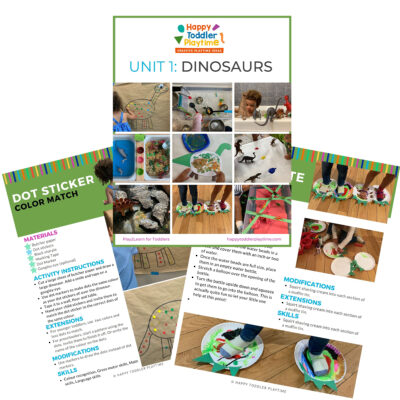
There is no limit to your toddler’s energy and curiosity. That energy and curiosity although a joy can be challenging at times. Their interest in just about everything around them is what makes them great learners. One and two year olds can soak up so much just from their senses!
But as a teacher or parent that thirst for learning can be exhausting. That is why I created this toddler and preschooler program. To help you get the most out of this time with your curious toddler without having to come up with creative ways to play and interact with them.
Play2Learn for Toddlers includes 20 Units for toddlers. Each 2-week toddler unit has 20 super easy to set up and engaging activities for toddlers 18 months to 3 years.
Play2Learn Preschool which includes 20 Units for preschoolers. Each 2-week preschoolers unit has 20 unique and easy to set up and engaging activities for preschoolers 3 years to 5 years. That’s over 800 learning activities for your toddler and preschooler at your fingertips! So many ideas you and your child will never be bored again!
These toddler and preschool lesson plans and activities will definitely keep you and your toddler and preschooler busy playing and learning!
Click here for more information: Play2Learn
Book: Exciting Sensory Bins for Curious Kids
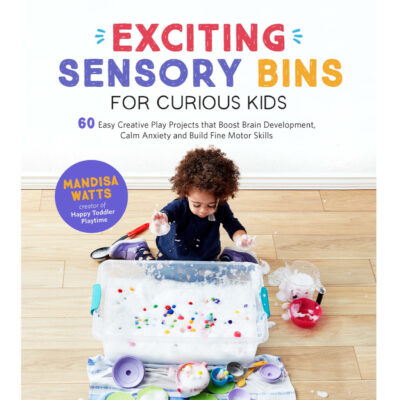
Did you know I wrote a book of sensory bins? Click here for more information Exciting Sensory Bin for Curious Kids. Or grab your copy at Amazon.
Boring afternoons are made exciting with awesome animal-based bins, like Salty Shark Bay or Yarn Farm. Pretend play bins like Birthday Cake Sensory Play or Bubble Tea Party encourage creativity and imagination. And your kids will have so much fun they won’t even know they’re getting smarter with STEAM (science, technology, engineering, art and math) activities like Sink or Float Soup, Magnetic Letter Hunt or Ice Cream Scoop and Count.
Designed for toddlers 18 months and up.
Book: Super STEAM Activity Book for Kids
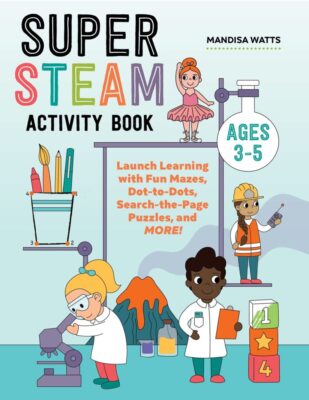
Learning all about science, technology, engineering, art, and math sets kids up for scholastic success―and it can be so much fun! Watch kids enjoy building STEAM skills as they color friendly fish, help water find its way to tree roots, solve math problems with mazes, and more.
Find out more and grab your copy here.
Designed for preschoolers 3 years old and up.
Book: Big Book of Riddles for Kids
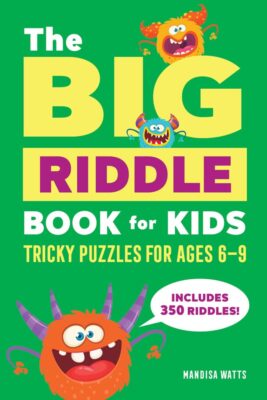
Riddle me this: What’s an exciting way to practice critical thinking while having a blast? The Big Riddle Book for Kids, of course! From hilarious puns to tough brain teasers, kids can build problem-solving skills with hundreds of riddles tha. t show them how to think outside the box.
- 350 riddles for kids—Have hours of fun with riddles, puns and jokes, and math and logic puzzles that’ll get their wheels turning!
- Level up their skills—Riddles get trickier as kids progress through the book, challenging them as they get better at solving puzzles!
- Double-check their work—Kids can check their answers in the back of the book with a handy answer key.
Help children expand their minds while having fun with this puzzle book for kids!
Designed for kids ages 6 years old and up.
TV Show: Curious Crafting
I’m so excited to share my crafting TV show Curious Crafting which launched in July 2022 on TVOkids and TVOkids YouTube! Season 2 aired in August 2023! My show was also nominated in 2023 for Best Live Action Preschool Series by the Youth Media Alliance Awards of Excellence.
Curious Crafting Season 1 is also now airing in Australia on ABC! Watch it here!
Set in the ultimate crafting space, Curious Crafting is a short form pre-school age series about the joy of making crafts. I lead a rotating cast of adorable little preschoolers (including my own) making magic out of common household objects.
In each episode we transform recycled items into magical crafts like a milk carton school bus, paper bag puppet or cotton pad turtle. The crafters learn and laugh their way through each activity while demonstrating what their young imaginations can create.
Curious Crafting shares the adventure and joy of making art with takeaway lessons for creating crafts at home.
This show designed for toddlers and preschoolers 2.5 years old and up.