

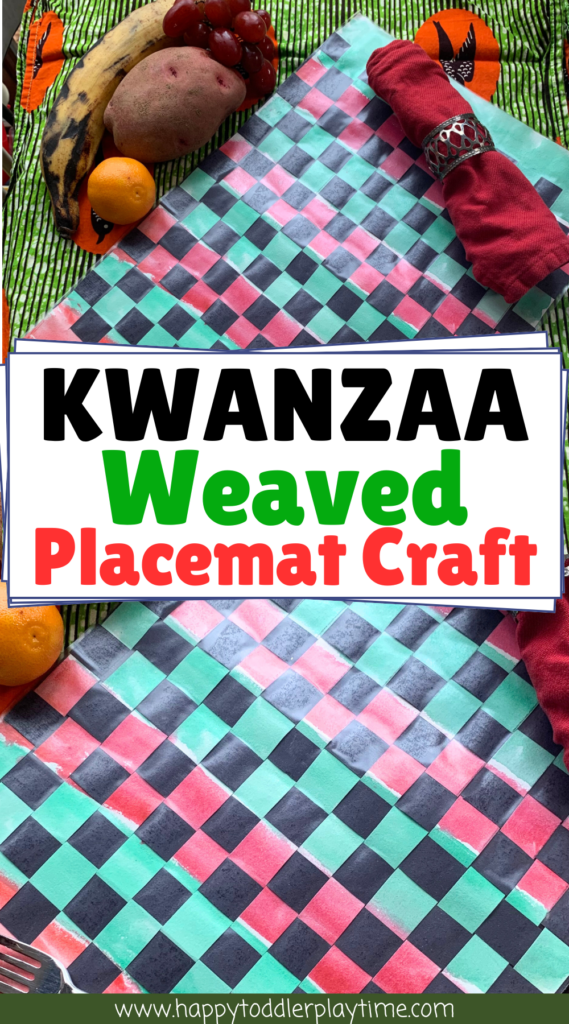
If you’re looking for a kid-friendly way to celebrate Kwanzaa that’s meaningful and hands-on, this Kwanzaa weaved placemat craft is perfect. It’s inspired by the mkeka, the traditional woven mat that sits at the center of the Kwanzaa table and holds the other symbols of the celebration. The mkeka represents heritage, history, and the foundation built on as a family and community—big ideas that kids can start to understand while they paint, cut, and weave.
This project uses the colors of Kwanzaa—red, black, and green—in a simple weaving activity that’s great for preschoolers, kindergartners, and early elementary kids. And because it’s made from sturdy paper and sealed with contact paper, your child can actually use it as a real placemat during Kwanzaa meals or snacks.
You can do this Kwanzaa craft at home, in the classroom, or as part of a Kwanzaa-themed family night. It’s a lovely mix of art, fine motor practice, cultural learning, and “look what I made!” pride.
Why You’ll Love This Kwanzaa Weaved Placemat Craft
- Connects to Kwanzaa symbols – A simple way to talk about the mkeka and the meaning of Kwanzaa in a kid-friendly way.
- Works for multiple ages – Little ones can help paint and weave with support, while older kids can measure, cut, and design independently.
- Lots of fine motor practice – Painting, cutting, lining up strips, and weaving all strengthen hand muscles for writing.
- Reusable keepsake – Once it’s covered in contact paper, it becomes a wipeable placemat your child can use every Kwanzaa.
- Minimal prep + supplies – Mostly paper, paint, scissors, and contact paper—easy to pull together.
Materials You’ll Need
- Watercolor paper (a heavier paper works best for painting and weaving)
- Red watercolor paint
- Green watercolor paint
- Paint brush
- Cup of water + paper towel for rinsing
- Ruler
- Scissors
- Black construction paper (for the weaving base)
- Clear contact paper (to laminate/cover the placemat)
- Optional: pencil for marking lines, black marker for writing your child’s name
Step-by-Step: How to Make a Kwanzaa Weaved Placemat
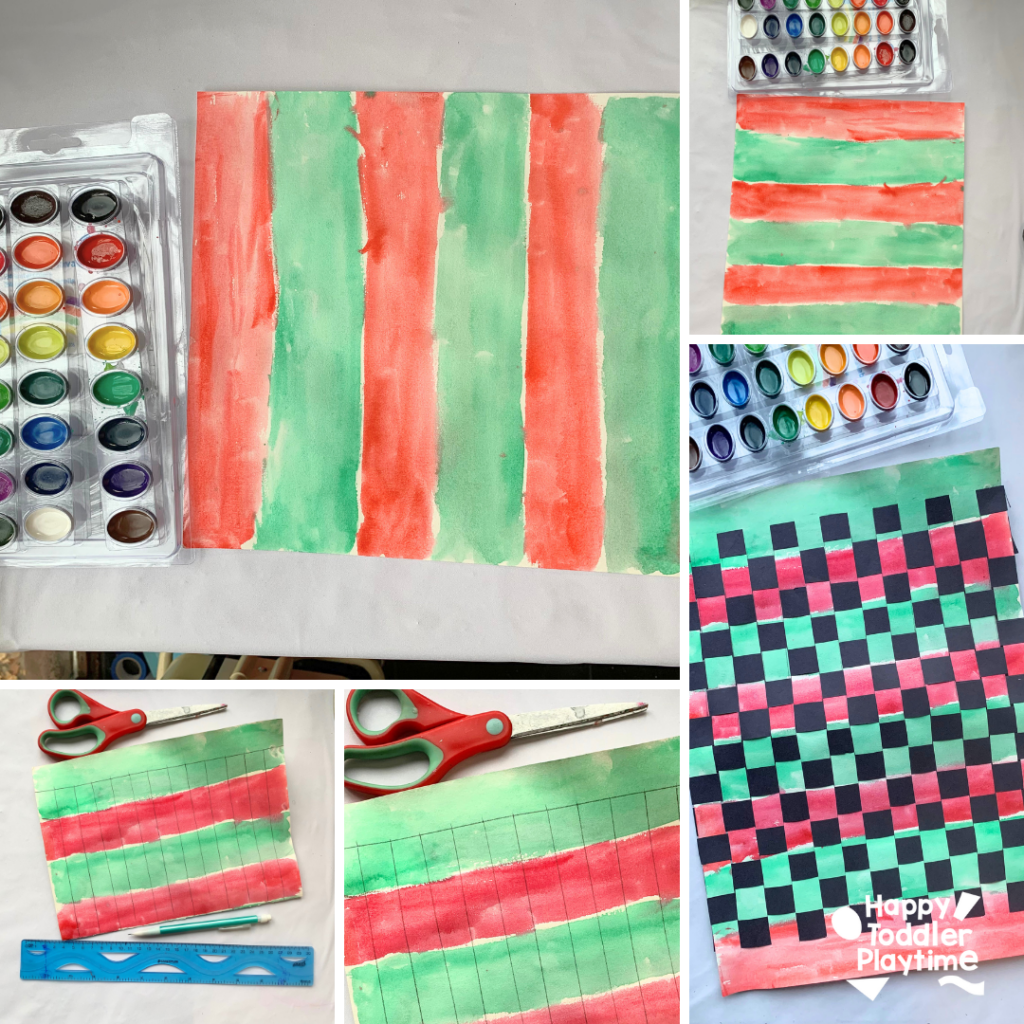
1. Paint Your Red and Green Paper
- Lay out your watercolor paper on a protected table surface.
- Use red and green watercolor paint to make stripes or swirls.
- Let painted page dry completely before cutting. You can speed this up with a fan or by doing the painting earlier in the day.
This step is a fun chance to talk about the colors of Kwanzaa and what they represent:
- Red – struggle and strength
- Green – hope and the future
- Black – the people
2. Create the “Mat”
- Fold the painted watercolor paper in half. Use a ruler and pencil to lightly draw straight lines from top to bottom, leaving about 1 inch uncut at the top and bottom.
- Each line should be about 1–1.5 cm (or ½ inch) apart to make nice weaving slots.
- Carefully cut along the lines from the bottom up, stopping at the top border so the paper stays in one piece.
You’ve now made a slotted “loom” for your placemat.
3. Cut Black Strips
- Take your black construction paper and use the ruler to mark strips about 1–1.5 cm wide.
- Cut along the lines to make long red strips.
Kids can help cut if they’re confident with scissors; otherwise, you can pre-cut strips and let them focus on the weaving.
4. Start Weaving
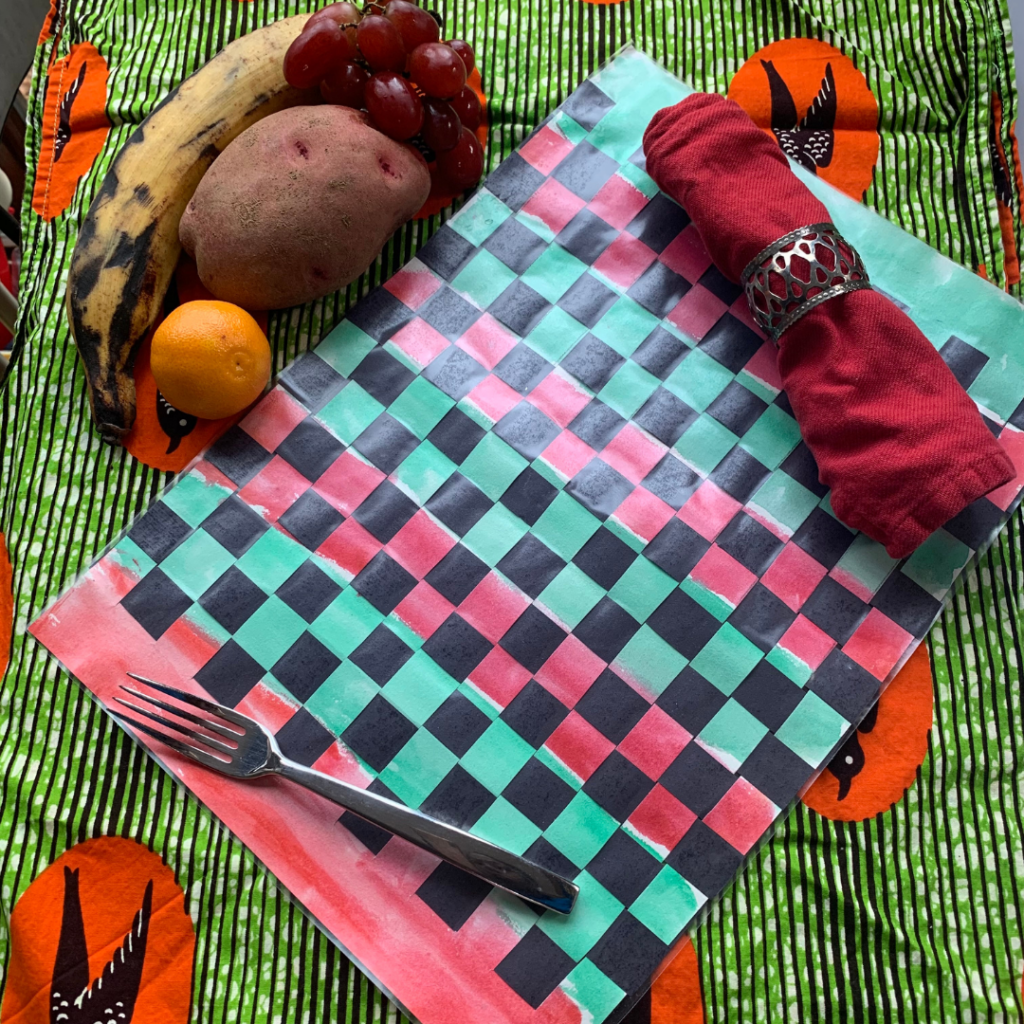
- Show your child how to weave by taking one black strip and sliding it over, under, over, under through the red and green slits.
- Push the strip up to the top of the placemat base.
- Take another black strip and weave it the opposite way: under, over, under, over, so the pattern alternates.
- Continue weaving black strips, until the whole red and green paper is filled.
You can trim any extra length hanging off the sides, or fold the ends behind the black paper and glue or tape them down for a neat edge.
This part is great for practicing patterns, focus, and hand-eye coordination. You can even say the pattern aloud: “Over, under, over, under…” as they go.
5. Seal It with Contact Paper
To make it into a real, reusable placemat:
- Cut a piece of clear contact paper slightly larger than your woven mat.
- Carefully peel back the contact paper backing and place it sticky-side up on the table (you can tape corners down).
- Gently place the woven mat face-down onto the sticky contact paper, smoothing out air bubbles.
- Cut another piece of contact paper the same size and place it on the back, sandwiching the mat in between.
- Press and smooth well, then trim the edges so it looks neat.
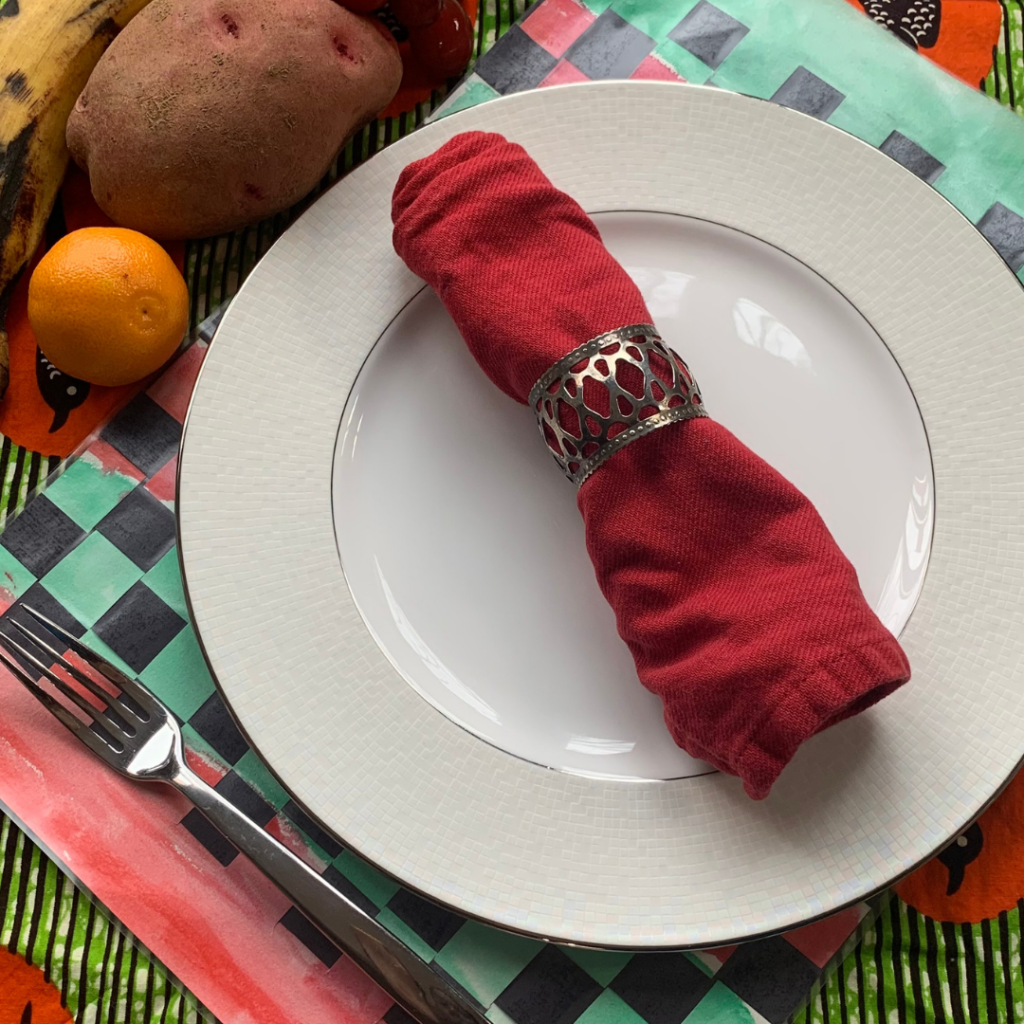
Now you have a laminated Kwanzaa placemat your child can actually use during meals and snacks!
Ways to Extend the Learning
- Talk about Kwanzaa principles while you work—unity, self-determination, creativity, and more.
- Pair this craft with a Kwanzaa book or short video to build context.
- Invite older kids to make a full set of placemats for the family.
- Use it under a Kwanzaa candle holder (kinara) or as a base for other Kwanzaa symbols.
This Kwanzaa weaved placemat craft is a beautiful blend of culture, art, and hands-on learning. It gives kids a tangible way to connect with the celebration and a special piece they can proudly use throughout Kwanzaa—and beyond.
Play2Learn Toddler & Preschool Programs for Curious Toddlers
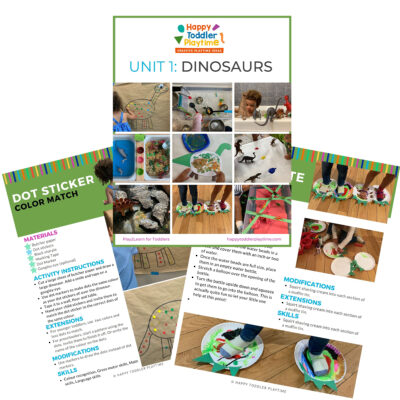
There is no limit to your toddler’s energy and curiosity. That energy and curiosity although a joy can be challenging at times. Their interest in just about everything around them is what makes them great learners. One and two year olds can soak up so much just from their senses!
But as a teacher or parent that thirst for learning can be exhausting. That is why I created this toddler and preschooler program. To help you get the most out of this time with your curious toddler without having to come up with creative ways to play and interact with them.
Play2Learn for Toddlers includes 20 Units for toddlers. Each 2-week toddler unit has 20 super easy to set up and engaging activities for toddlers 18 months to 3 years.
Play2Learn Preschool which includes 20 Units for preschoolers. Each 2-week preschoolers unit has 20 unique and easy to set up and engaging activities for preschoolers 3 years to 5 years. That’s over 800 learning activities for your toddler and preschooler at your fingertips! So many ideas you and your child will never be bored again!
These toddler and preschool lesson plans and activities will definitely keep you and your toddler and preschooler busy playing and learning!
Click here for more information: Play2Learn
Book: Exciting Sensory Bins for Curious Kids
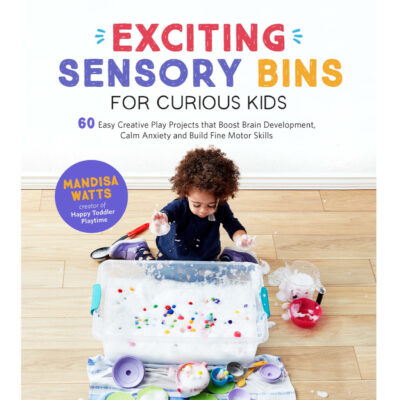
Did you know I wrote a book of sensory bins? Click here for more information Exciting Sensory Bin for Curious Kids. Or grab your copy at Amazon.
Boring afternoons are made exciting with awesome animal-based bins, like Salty Shark Bay or Yarn Farm. Pretend play bins like Birthday Cake Sensory Play or Bubble Tea Party encourage creativity and imagination. And your kids will have so much fun they won’t even know they’re getting smarter with STEAM (science, technology, engineering, art and math) activities like Sink or Float Soup, Magnetic Letter Hunt or Ice Cream Scoop and Count.
Designed for toddlers 18 months and up.
Book: Super STEAM Activity Book for Kids
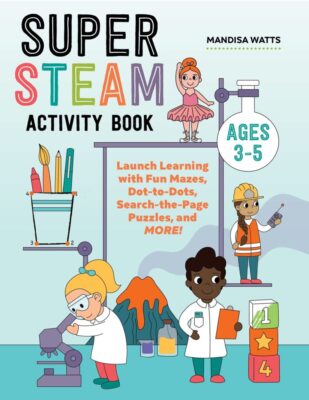
Learning all about science, technology, engineering, art, and math sets kids up for scholastic success―and it can be so much fun! Watch kids enjoy building STEAM skills as they color friendly fish, help water find its way to tree roots, solve math problems with mazes, and more.
Find out more and grab your copy here.
Designed for preschoolers 3 years old and up.
Book: Big Book of Riddles for Kids
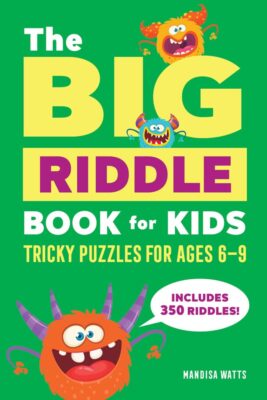
Riddle me this: What’s an exciting way to practice critical thinking while having a blast? The Big Riddle Book for Kids, of course! From hilarious puns to tough brain teasers, kids can build problem-solving skills with hundreds of riddles tha. t show them how to think outside the box.
- 350 riddles for kids—Have hours of fun with riddles, puns and jokes, and math and logic puzzles that’ll get their wheels turning!
- Level up their skills—Riddles get trickier as kids progress through the book, challenging them as they get better at solving puzzles!
- Double-check their work—Kids can check their answers in the back of the book with a handy answer key.
Help children expand their minds while having fun with this puzzle book for kids!
Designed for kids ages 6 years old and up.
TV Show: Curious Crafting
I’m so excited to share my crafting TV show Curious Crafting which launched in July 2022 on TVOkids and TVOkids YouTube! Season 2 aired in August 2023! My show was also nominated in 2023 for Best Live Action Preschool Series by the Youth Media Alliance Awards of Excellence.
Curious Crafting Season 1 is also now airing in Australia on ABC! Watch it here!
Set in the ultimate crafting space, Curious Crafting is a short form pre-school age series about the joy of making crafts. I lead a rotating cast of adorable little preschoolers (including my own) making magic out of common household objects.
In each episode we transform recycled items into magical crafts like a milk carton school bus, paper bag puppet or cotton pad turtle. The crafters learn and laugh their way through each activity while demonstrating what their young imaginations can create.
Curious Crafting shares the adventure and joy of making art with takeaway lessons for creating crafts at home.
This show designed for toddlers and preschoolers 2.5 years old and up.