
Easter is a fun and festive time that provides the perfect opportunity for kids to engage in hands-on, creative STEAM activities. Incorporating STEAM (Science, Technology, Engineering, Arts, and Math) activities into Easter festivities is a great way to encourage children’s curiosity, critical thinking, and problem-solving skills.
We have compiled a list of exciting and engaging Easter STEAM ideas that kids of all ages can enjoy. From creating egg drop challenges to designing and building their own Easter-themed structures, these activities will inspire children to explore the wonders of STEAM while celebrating the joy and magic of Easter. So, let’s hop into these fun and educational Easter STEAM ideas that are sure to spark children’s imaginations and keep them entertained all season long!

Looking for more Easter Crafts, Activities, Hunts or Basket ideas? Check out these amazing resources:
- Easter Basket Ideas for Babies
- Easter Basket Ideas for Toddlers & Preschoolers
- Easter Crafts for Toddlers & Preschoolers
- Easter Bunny Crafts & Activities for Kids
- DIY Easter Egg Decorating Ideas
- Easter Egg Hunt Ideas for Kids
- Chick Crafts for Kids
- Easter STEAM Activities
What is STEAM?
STEAM (Science, Technology, Engineering, Arts, and Math) learning is an educational approach that integrates various disciplines to foster critical thinking, problem-solving, and creativity in students. This interdisciplinary approach is designed to encourage students to explore and learn about the world around them through hands-on, interactive experiences.
Science, Technology, Engineering, and Math are the core subjects that make up the STEAM approach. These subjects provide students with essential skills and knowledge in areas such as physics, chemistry, biology, computer science, mathematics, and engineering. By combining these subjects, students are encouraged to think outside the box and find innovative solutions to real-world problems.
Arts, the fifth component of STEAM learning, provides a creative outlet for students to explore their imagination and express their ideas. By integrating art into STEM subjects, students are encouraged to think creatively and critically about the problems they are trying to solve. Art can also help students to visualize and communicate complex ideas, making it an essential part of the STEAM approach.
Benefits of STEAM Learning for Kids
One of the key benefits of STEAM learning is that it helps students develop essential skills that are highly valued in the modern workforce. These skills include problem-solving, critical thinking, collaboration, communication, and creativity. By engaging in hands-on, interdisciplinary learning experiences, students can develop a deep understanding of how different subjects relate to each other and how they can be applied to solve modern day dilemmas.
In addition to developing essential skills, STEAM learning can also help to inspire students to pursue careers in science, technology, engineering, and math fields. By providing students with engaging and exciting learning experiences, STEAM can help to break down barriers and encourage more students, including girls and underrepresented minorities, to pursue careers in these fields.

Easter STEAM Activities for Kids
1. Sink the Easter Egg STEM Challenge
Sink the Easter Egg STEM Challenge is a fun activity that toddlers, preschoolers and kindergartners will enjoy! Can your little one guess what will sink the Easter eggs?

2. Tubes and Easter Eggs
Here is a fun and crazy quick to set up Easter activity that only requires two things and one excites toddler or preschooler.

3. Fizzy Paint Easter Bunny Craft
Fizzy Painted Easter Bunny Craft is a great STEAM themed craft for kids. It uses the simple kitchen science experiment between baking soda and vinegar to great a unique piece of art!! This easy STEAM craft is so fun and easy for big and small kids! And it makes a great Easter gift for loved ones!

4. Easter Egg Magnetic Maze
Create a simple Easter egg maze for your kids using the power of magnets! This is a fun indoor activity that can lead to lots of free play with magnets!

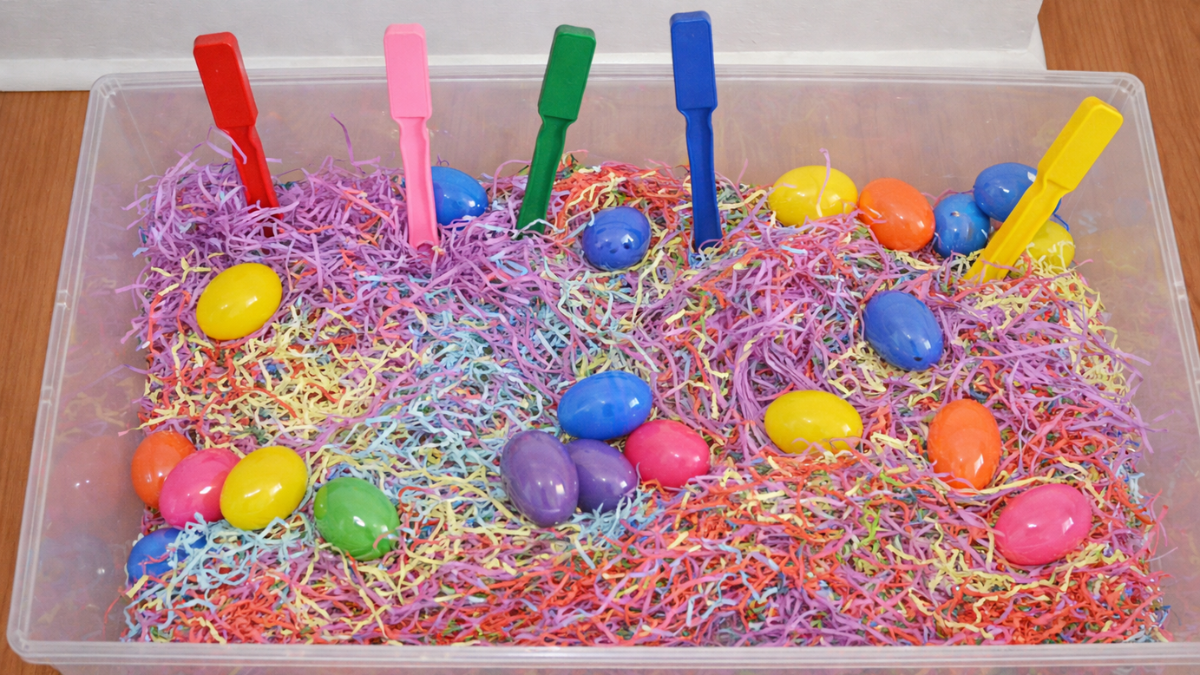
5. Magnetic Easter Egg Hunt
This was a super fun Easter egg activity we did today after school. It was simple to set up and lots of fun for my three year old! But not only was it fun it also provided lots opportunity for learning!
6. Borax Crystal Easter Eggs (Kid-Friendly Science Craft)

Materials:
- Styrofoam Easter eggs
- Borax (laundry booster)
- Hot water (very hot for best crystals)
- Glass jars or cups (one per egg)
- String or yarn
- Pencil, skewer, or popsicle stick (to suspend egg)
- Food coloring (optional)
- Spoon (for stirring)
- Scissors
How to Make Borax Crystal Eggs:
- Tie a piece of string to the egg and then tie the other end to a pencil or stick so the egg can hang in the jar without touching the sides.
- Fill a jar with very hot water. Stir in borax, about 3–4 tablespoons per cup of water, until it stops dissolving (this is a saturated solution).
- Add a few drops of food coloring if you want colored crystals.
- Lower the egg into the jar so it is fully covered but not touching the bottom or sides.
- Leave undisturbed for several hours or overnight to 1-2 days. Crystals will begin forming as the water cools.
- Carefully lift the egg out and let it dry on paper towels.
Tips for Success:
- The hotter the water, the better the crystals grow.
- Don’t move the jar while crystals are forming.
- Use clear jars so kids can observe the process.
7. Easter Peeps Dissolving Science Experiment

Materials:
- Easter Peeps (same color/type for consistency)
- Clear cups or jars (3–4)
- Water
- Vinegar
- Oil (great safe option that won’t dissolve them)
- Soda
- Fork
- Paper and pencil (for predictions)
How to Set Up:
- Place one Peep into each clear cup.
- Pour a different liquid into each cup (water, vinegar, soda, and oil), making sure the Peeps are fully covered.
- Before starting, have kids say or write their predictions about what will happen to each Peep in each liquid.
- Leave the cups undisturbed for 2 days.
- After 2 days, observe what happened to each Peep—look at size, texture, and color.
- Use a fork to gently press each Peep and see how it has changed (dissolved, stretched, hardened, etc.).
What Kids Will Notice:
- Water will slowly dissolve the sugar coating and marshmallow.
- Vinegar breaks it down faster and can make it look mushy.
- Oil won’t dissolve the Peep at all, showing how some liquids don’t mix with sugar.
8. Fizzy Easter Eggs (Baking Soda + Vinegar)

Materials:
- Plastic Easter eggs
- Baking soda
- Vinegar (in a squeeze bottle or dropper)
- Food coloring
- Tray or bin (to contain the mess)
- Spoon
How to Set Up:
- Fill each plastic Easter egg half with baking soda.
- Add a few drops of food coloring to the baking soda and gently mix.
- Place the eggs in a tray or bin.
- Give kids a squeeze bottle or dropper filled with vinegar.
- Let them squeeze vinegar into the eggs and watch the fizzy reaction.
9. Easter Slime (Simple & Kid-Friendly)

Materials:
- White school glue (Elmer’s or similar)
- Baking soda
- Contact lens solution (must contain boric acid)
- Food coloring (pastels work great)
- Glitter, foam beads, or Easter sprinkles (optional)
- Bowl and spoon
- Plastic Easter eggs (for storage or hiding slime)
How to Set Up:
- Add 1/2 cup of white glue to a bowl.
- Mix in 1/2 teaspoon of baking soda.
- Add a few drops of food coloring and stir until combined.
- Mix in glitter, foam beads, or sprinkles if using.
- Add 1 tablespoon of contact lens solution and stir.
- Continue mixing until slime forms and pulls away from the bowl.
- Knead with hands until smooth and stretchy (add a few more drops of solution if sticky).
Tips for Success:
- Add activator slowly—too much will make slime stiff.
- Wash hands before and after playing.
- Store in airtight containers or plastic eggs to keep it fresh.
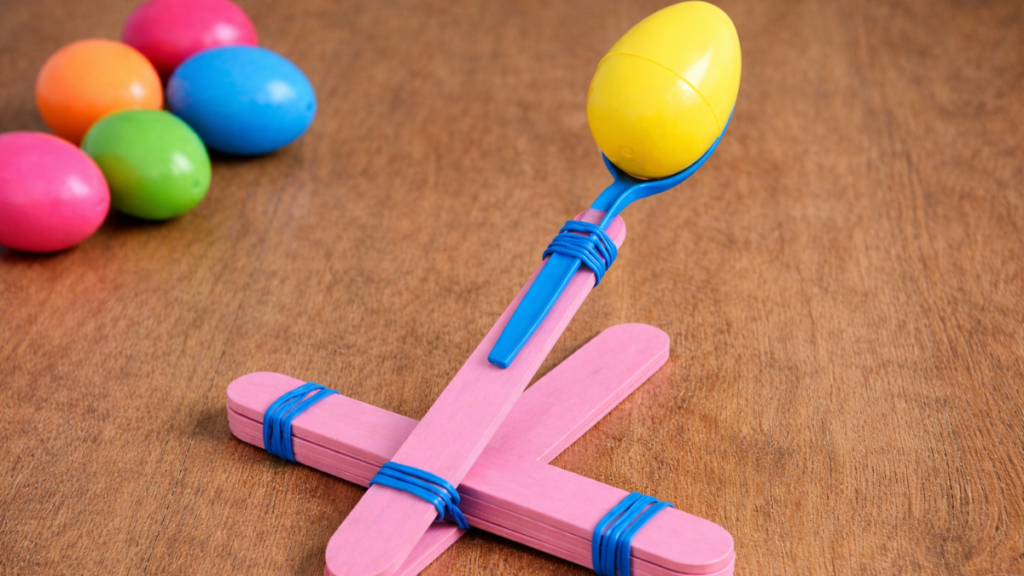
10. Easter Egg Catapult

Materials:
- Plastic spoon
- 6–8 popsicle sticks
- 3–5 elastic bands
- Plastic Easter eggs (lightweight works best)
How to Set Up:
- Stack 5–7 popsicle sticks together and wrap an elastic band tightly around each end to hold them in a bundle.
- Take one more popsicle stick and the spoon, place the spoon on top of the stick, and secure them together with an elastic band at the handle.
- Slide this spoon-stick piece over the stacked bundle so it forms a lever and another stick under the stacked bundle. Wrap another elastic band around the center where they meet to hold everything in place.
- Place a plastic Easter egg in the spoon, press down, and release to launch.
11. Salt Crystal Easter Eggs

Materials:
- Pipe cleaners (any color)
- Table salt (regular or coarse works best)
- Warm water
- Clear jar or cup
- Spoon (for stirring)
- String or yarn
- Pencil or stick (to suspend the egg)
- Food coloring (optional, for tinted crystals)
How to Make:
- Bend a pipe cleaner into a simple oval egg shape. Twist the ends together to secure.
- Tie a piece of string to the top of the pipe cleaner egg. Tie the other end to a pencil or stick so it can hang in the jar without touching the sides or bottom.
- Fill a jar with warm water and stir in salt one spoonful at a time until no more will dissolve (this creates a saturated solution).
- Add a few drops of food coloring if you want colored crystals.
- Lower the pipe cleaner egg into the jar so it is fully submerged and suspended.
- Leave it undisturbed for 1–3 days. Crystals will begin to grow on the pipe cleaner.
- Carefully take the egg out and let it dry on paper towels.
12. Easter Egg Stacking Challenge
Materials:
- Plastic Easter eggs (variety of sizes/colors if possible)
- Flat surface or tray
- Optional: timer
How to Set Up:
- Give each child a pile of plastic Easter eggs.
- Challenge them to stack the eggs as high as they can without them falling.
- Encourage trying different ways—halves, whole eggs, or mixing sizes.
- Add a timer to make it more exciting (e.g., 1-minute challenge).
- Reset and try again to beat their height.
13. Build an Easter Peep Boat for Kids

Materials:
- Easter Peeps
- Aluminum foil, sponge, or craft foam (for the base)
- Toothpicks or skewers
- Paper (for sails)
- Tape
- Scissors
- Large bin or container of water
How to Set Up:
- Give each child materials to build a small boat.
- Use foil, sponge, or foam as the base of the boat.
- Add a Peep on top as the “passenger.”
- Use toothpicks and paper to create a sail if desired.
- Gently place the boat in water to test if it floats.
- Challenge kids to redesign their boat if it tips or sinks.
14. Easter Egg Ramps

Materials:
- Plastic Easter eggs
- Cardboard (cut into ramp pieces)
- Books or boxes (to prop ramps)
- Tape
- Scissors
- Timer (optional)
- Small items to add inside eggs (coins, rice, beads)
How to Set Up:
- Build simple ramps using cardboard and prop them up with books or boxes.
- Place a plastic egg at the top of the ramp and release it to roll down.
- Try different ramp heights and angles to see how it changes the speed.
- Test eggs with different weights by adding items inside.
- Race two eggs side by side to compare results.
15. Easter Egg Zip Line

Materials:
- Plastic Easter eggs (the kind that open)
- Pipe cleaners (various colors)
- String or twine (for the zip line)
- Tape (optional, for securing the string)
- Small lightweight items (paper bunny, chick cutouts, mini toys, etc.)
- Two anchor points (chairs, table legs, or a simple stick/post setup)
How to Make:
- Tie a piece of string tightly between two points (chairs, table legs, or posts). Angle it slightly downward so the eggs can slide.
- Take a pipe cleaner and loop it through the small holes at the top of each plastic egg (or wrap it securely around the egg). Twist the top together to form a loop or “hanger.”
- Slide the pipe cleaner loop over the string so the egg can hang and move freely.
- Place a small paper bunny, chick, or mini item inside each egg and snap it closed.
- Lift the egg to the top of the string and let it go—watch it zip down!
16. Build Your Own Easter Basket

Materials:
- Pipe cleaners (lots of colors)
- Glue (hot glue or tacky glue for sturdiness)
- Scissors (optional)
- Small decorations (foam flowers, bows, stickers – optional)
- Plastic Easter eggs or small items (for filling)
How to Make:
- Take a pipe cleaner and shape it into a circle. Twist the ends together to secure. This will be the bottom of your basket.
- To make the bottom of the basket, wrap pipe cleaners across the circle. Secure the ends to the circle. Continue adding until there is enough support to hold an easter egg.
- Wrap additional pipe cleaners around the base ring, stacking them upward in a spiral or layered pattern. Add a small dab of glue as needed to keep everything in place.
- Continue wrapping until the basket walls are about 2–3 inches high. Press gently to shape it into a neat round basket.
- Twist 2–3 pipe cleaners together to make a thicker handle. Attach each end securely to opposite sides of the basket by twisting or gluing.
- Add foam flowers, bows, or extra pipe cleaner details for a fun Easter look.
- Add plastic eggs or small treats and your basket is ready to use!
Play2Learn Toddler & Preschool Programs for Curious Toddlers
There is no limit to your toddler’s energy and curiosity. That energy and curiosity although a joy can be challenging at times. Their interest in just about everything around them is what makes them great learners. One and two year olds can soak up so much just from their senses!
But as a teacher or parent that thirst for learning can be exhausting. That is why I created this toddler and preschooler program. To help you get the most out of this time with your curious toddler without having to come up with creative ways to play and interact with them.
Play2Learn for Toddlers includes 20 Units for toddlers. Each 2-week toddler unit has 20 super easy to set up and engaging activities for toddlers 18 months to 3 years.
Play2Learn Preschool which includes 20 Units for preschoolers. Each 2-week preschoolers unit has 20 unique and easy to set up and engaging activities for preschoolers 3 years to 5 years. That’s over 800 learning activities for your toddler and preschooler at your fingertips! So many ideas you and your child will never be bored again!
These toddler and preschool lesson plans and activities will definitely keep you and your toddler and preschooler busy playing and learning!
Click here for more information: Play2Learn
Book: Exciting Sensory Bins for Curious Kids
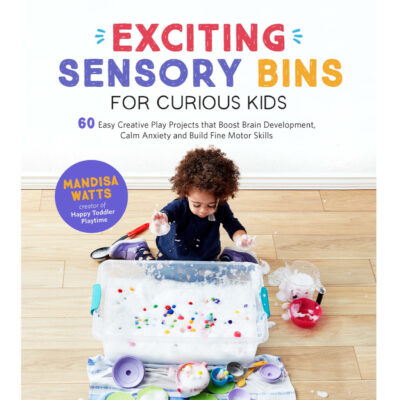
Did you know I wrote a book of sensory bins? Click here for more information Exciting Sensory Bin for Curious Kids. Or grab your copy at Amazon.
Boring afternoons are made exciting with awesome animal-based bins, like Salty Shark Bay or Yarn Farm. Pretend play bins like Birthday Cake Sensory Play or Bubble Tea Party encourage creativity and imagination. And your kids will have so much fun they won’t even know they’re getting smarter with STEAM (science, technology, engineering, art and math) activities like Sink or Float Soup, Magnetic Letter Hunt or Ice Cream Scoop and Count.
Designed for toddlers 18 months and up.
Book: Super STEAM Activity Book for Kids
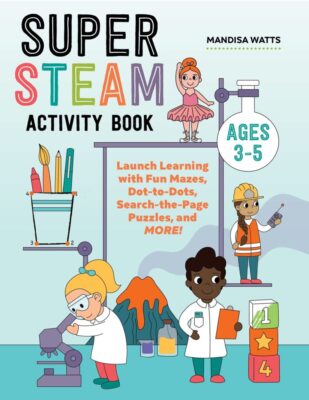
Learning all about science, technology, engineering, art, and math sets kids up for scholastic success―and it can be so much fun! Watch kids enjoy building STEAM skills as they color friendly fish, help water find its way to tree roots, solve math problems with mazes, and more.
Find out more and grab your copy here.
Designed for preschoolers 3 years old and up.
Book: Big Book of Riddles for Kids
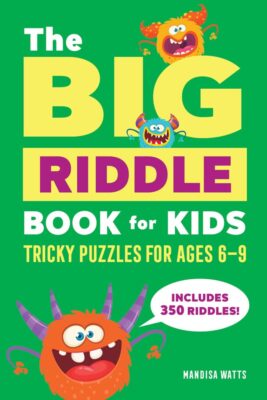
Riddle me this: What’s an exciting way to practice critical thinking while having a blast? The Big Riddle Book for Kids, of course! From hilarious puns to tough brain teasers, kids can build problem-solving skills with hundreds of riddles tha. t show them how to think outside the box.
- 350 riddles for kids—Have hours of fun with riddles, puns and jokes, and math and logic puzzles that’ll get their wheels turning!
- Level up their skills—Riddles get trickier as kids progress through the book, challenging them as they get better at solving puzzles!
- Double-check their work—Kids can check their answers in the back of the book with a handy answer key.
Help children expand their minds while having fun with this puzzle book for kids!
Designed for kids ages 6 years old and up.
TV Show: Curious Crafting
I’m so excited to share my crafting TV show Curious Crafting which launched in July 2022 on TVOkids and TVOkids YouTube! Season 2 aired in August 2023! My show was also nominated in 2023 for Best Live Action Preschool Series by the Youth Media Alliance Awards of Excellence.
Curious Crafting Season 1 is also now airing in Australia on ABC! Watch it here!
Set in the ultimate crafting space, Curious Crafting is a short form pre-school age series about the joy of making crafts. I lead a rotating cast of adorable little preschoolers (including my own) making magic out of common household objects.
In each episode we transform recycled items into magical crafts like a milk carton school bus, paper bag puppet or cotton pad turtle. The crafters learn and laugh their way through each activity while demonstrating what their young imaginations can create.
Curious Crafting shares the adventure and joy of making art with takeaway lessons for creating crafts at home.
This show designed for toddlers and preschoolers 2.5 years old and up.