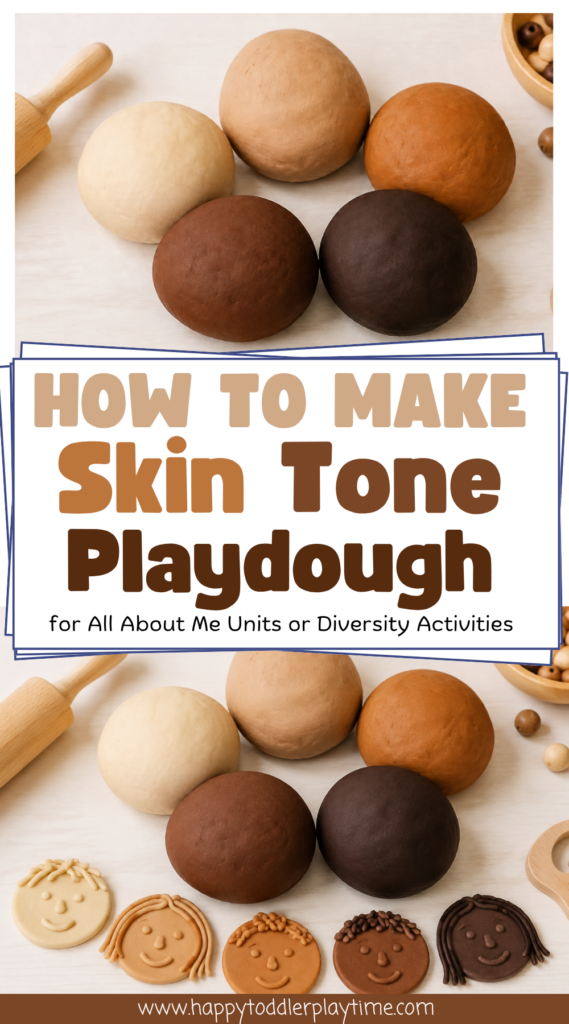

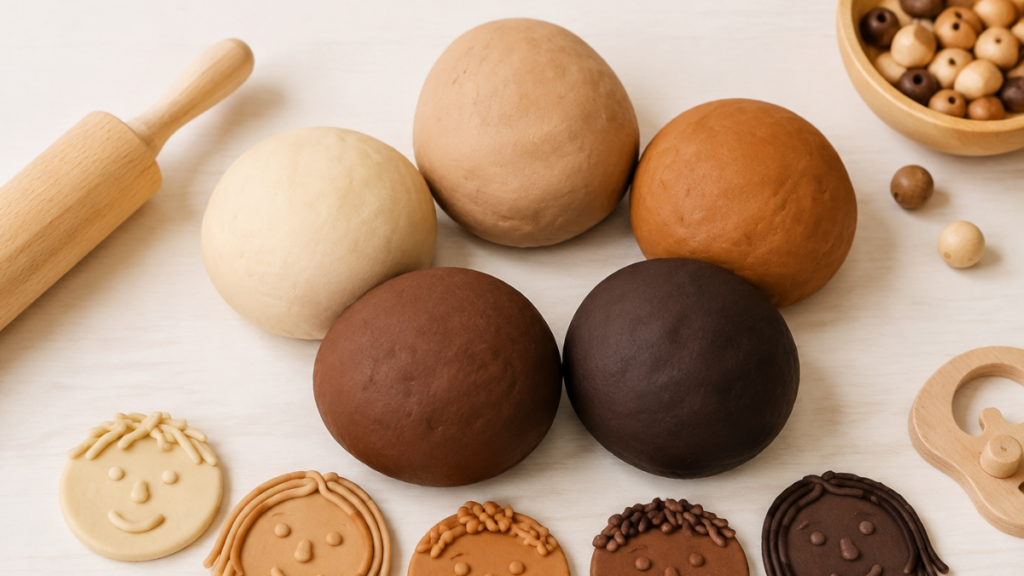
Making skin tone playdough is a wonderful way to celebrate diversity through creative, hands-on play. It is also a great addition to any All About Me preschool unit or back to school activity. Children can use it to create self-portraits, families, friends, and imaginative characters that reflect the many beautiful shades of human skin.
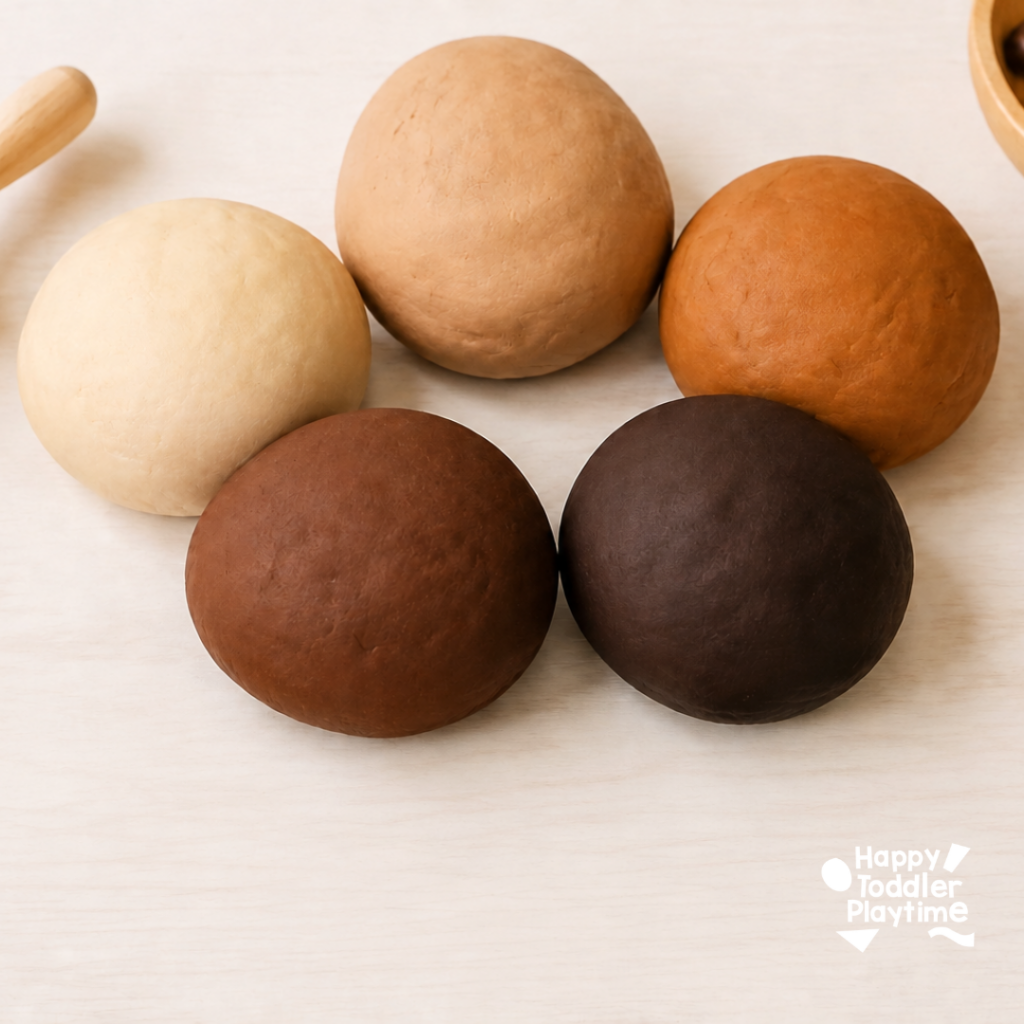
This recipe creates five different skin tone playdough colors. They are starting points rather than exact matches—encourage children to adjust the colors until they find a shade that feels right to them.
Homemade Playdough Ingredients
You will need:
- 2 cups all-purpose flour
- ¾ cup salt
- 4 teaspoons cream of tartar
- 2 tablespoons vegetable oil
- 2 cups water
- Gel food coloring in brown, red, yellow, and blue
- Five airtight containers or resealable bags
Gel food coloring creates richer colors without making the dough sticky. Liquid food coloring will also work, but you may need to use more.
Adult supervision is required when cooking the playdough.
How to Make the Playdough Base
- Add the flour, salt, and cream of tartar to a large saucepan. Stir until combined.
- Pour in the water and vegetable oil. Whisk the mixture until most of the lumps have disappeared.
- Cook over medium-low heat, stirring continuously. The mixture will gradually thicken and begin pulling away from the sides of the pan.
- When the dough forms a ball and no longer looks wet, remove the pan from the heat.
- Place the dough on a heat-safe surface. Allow it to cool until it is comfortable to handle.
- Knead the dough for two to three minutes, or until it becomes smooth and soft.
- Divide the playdough into five equal portions.
How to Make Five Skin Tone Playdough Colors
Food coloring brands vary, so treat these color combinations as starting points. Add color gradually—a tiny amount can make a big difference.
For the best results, flatten each portion of dough, add the coloring to the center, fold the dough over, and knead until the color is evenly distributed. Wear gloves or knead the dough inside a resealable bag if you want to prevent stained hands.
1. Light Skin Tone
Begin with:
- A tiny touch of yellow
- A toothpick-sized touch of red
- The smallest speck of brown
Knead the colors into the dough. If the shade looks too pink, add a little yellow. If it is too bright, add an extremely small amount of brown.
2. Light-Medium Skin Tone
Begin with:
- 2 small drops of yellow
- 1 small drop of red
- 1 small drop of brown
Knead thoroughly. Add another touch of brown for more depth or a tiny amount of uncolored dough to make the shade lighter.
3. Medium Skin Tone
Begin with:
- 2 small drops of brown
- 2 small drops of yellow
- 1 small drop of red
Mix until the color is even. Add yellow for a warmer undertone or a tiny speck of blue for a cooler, more neutral undertone.
4. Deep Tan Skin Tone
Begin with:
- 4 small drops of brown
- 2 small drops of yellow
- 1 small drop of red
Knead the dough well before adding more coloring. Deepen the shade with brown or warm it with a little additional yellow or red.
5. Rich Deep Skin Tone
Begin with:
- 6 small drops of brown
- 1 small drop of red
- 1 small drop of yellow
- An optional tiny speck of blue
The blue helps neutralize the orange tones, but use it sparingly. Add more brown one small drop at a time until you reach the desired depth.
Tips for Mixing the Colors
Skin tones contain many different undertones. Small adjustments can make each playdough color more personal and realistic.
- Add yellow to make a shade warmer or more golden.
- Add red to create a warmer or rosier undertone.
- Add a tiny amount of blue to cool or neutralize a shade.
- Add brown to deepen the color.
- Add uncolored playdough to lighten the color.
- Blend two finished shades to create a new color.
Remind children that there is no single “correct” skin color. Every person’s coloring is unique, and the goal is to explore and celebrate those differences.
How to Use Skin Tone Playdough
Make Playdough Self-Portraits
Invite each child to select or mix a shade that resembles their skin. They can shape a face and add eyes, hair, a nose, a mouth, and other features using loose craft materials or additional playdough.
Create Families and Friends
Children can make models of the people who are important to them. Encourage them to notice that people within the same family may have different skin tones, hair textures, and facial features.
Explore Color Mixing
Provide small portions of the five shades and let children experiment. Ask questions such as:
- What happens when you mix these two colors?
- How can you make this shade warmer?
- What could you add to make it lighter or deeper?
- Can you create a color that resembles your own skin?
Build Faces and Explore Emotions
Make playdough faces showing happiness, sadness, excitement, worry, or surprise. This activity combines creative play with conversations about feelings and facial expressions.
Use It for Storytelling
Children can create a diverse group of playdough characters and use them in imaginative stories. Add blocks, toy furniture, or natural materials to build homes, schools, parks, and neighborhoods.
Practice Fine Motor Skills
Rolling, squeezing, pinching, flattening, and shaping playdough strengthens the small muscles children use for drawing, writing, fastening clothing, and other everyday tasks.
Respectful Conversations During the Activity
Use positive, neutral words such as light, medium, deep, warm, cool, golden, and rosy when discussing colors. Avoid describing one shade as “normal,” “regular,” “dirty,” or “better” than another.
Let children decide which shade represents them. If none of the original colors feels right, help them create a custom blend.
Frequently Asked Questions
Q: How long does homemade playdough last?
When stored correctly, homemade playdough can remain usable for several weeks or even a few months. Discard it if you notice mold, an unusual smell, or a significant change in texture.
Q: How should I store skin tone playdough?
Keep each color in a separate airtight container or resealable bag. Store the containers in a cool, dry place. Keeping the colors separate prevents them from blending between play sessions.
Q: What should I do if the playdough is sticky?
Knead in a small amount of flour, about one teaspoon at a time. Avoid adding too much, as excess flour can make the dough dry and crumbly.
Q: What should I do if the playdough becomes dry?
Work a few drops of water or vegetable oil into the dough. Add only a little at a time and knead well before adding more.
Q: Will the food coloring stain hands or surfaces?
Concentrated coloring may temporarily stain hands, clothing, or porous surfaces. Protect the work area and consider wearing gloves while initially mixing the colors. Once the coloring is fully incorporated, staining is less likely.
Q: Is this playdough edible?
No. Although the ingredients are commonly used in cooking, the dough contains a large amount of salt and is not intended to be eaten. Supervise young children and children who frequently place objects in their mouths.
Q: Can children help make the playdough?
Children can measure the cool ingredients and help knead the finished dough after it has cooled completely. An adult should handle the stove and hot mixture.
Q: Can I make the colors without brown food coloring?
Yes. Combine red, yellow, and a very small amount of blue to make brown. Mix the colors separately first, then add the resulting brown coloring to the dough gradually.
Q: Can I use natural coloring?
Yes, although natural ingredients may produce softer shades and can change the scent or texture. Cocoa powder can deepen the dough, while small amounts of turmeric or beet powder can add golden or rosy undertones. Be aware of allergies, staining, and possible spoilage when using food-based colorants.
Celebrating Every Shade
Skin tone playdough offers more than a fun sensory experience. It gives children an opportunity to see themselves represented, appreciate differences, and discover how many colors can exist within one wonderfully diverse human family.
Begin with these five shades, then keep mixing. The most meaningful color may be the one a child creates for themselves.
Play2Learn Toddler & Preschool Programs for Curious Toddlers
There is no limit to your toddler’s energy and curiosity. That energy and curiosity although a joy can be challenging at times. Their interest in just about everything around them is what makes them great learners. One and two year olds can soak up so much just from their senses!
But as a teacher or parent that thirst for learning can be exhausting. That is why I created this toddler and preschooler program. To help you get the most out of this time with your curious toddler without having to come up with creative ways to play and interact with them.
Play2Learn for Toddlers includes 20 Units for toddlers. Each 2-week toddler unit has 20 super easy to set up and engaging activities for toddlers 18 months to 3 years.
Play2Learn Preschool which includes 20 Units for preschoolers. Each 2-week preschoolers unit has 20 unique and easy to set up and engaging activities for preschoolers 3 years to 5 years. That’s over 800 learning activities for your toddler and preschooler at your fingertips! So many ideas you and your child will never be bored again!
These toddler and preschool lesson plans and activities will definitely keep you and your toddler and preschooler busy playing and learning!
Click here for more information: Play2Learn
Book: Exciting Sensory Bins for Curious Kids
Did you know I wrote a book of sensory bins? Click here for more information Exciting Sensory Bin for Curious Kids. Or grab your copy at Amazon.
Boring afternoons are made exciting with awesome animal-based bins, like Salty Shark Bay or Yarn Farm. Pretend play bins like Birthday Cake Sensory Play or Bubble Tea Party encourage creativity and imagination. And your kids will have so much fun they won’t even know they’re getting smarter with STEAM (science, technology, engineering, art and math) activities like Sink or Float Soup, Magnetic Letter Hunt or Ice Cream Scoop and Count.
Designed for toddlers 18 months and up.
Book: Super STEAM Activity Book for Kids
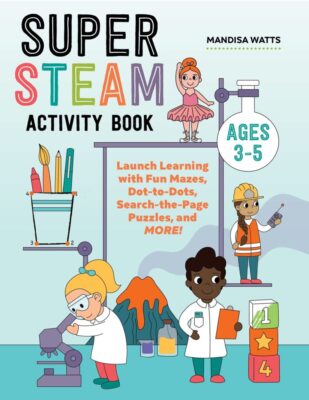
Learning all about science, technology, engineering, art, and math sets kids up for scholastic success―and it can be so much fun! Watch kids enjoy building STEAM skills as they color friendly fish, help water find its way to tree roots, solve math problems with mazes, and more.
Find out more and grab your copy here.
Designed for preschoolers 3 years old and up.
Book: Big Book of Riddles for Kids

Riddle me this: What’s an exciting way to practice critical thinking while having a blast? The Big Riddle Book for Kids, of course! From hilarious puns to tough brain teasers, kids can build problem-solving skills with hundreds of riddles tha. t show them how to think outside the box.
- 350 riddles for kids—Have hours of fun with riddles, puns and jokes, and math and logic puzzles that’ll get their wheels turning!
- Level up their skills—Riddles get trickier as kids progress through the book, challenging them as they get better at solving puzzles!
- Double-check their work—Kids can check their answers in the back of the book with a handy answer key.
Help children expand their minds while having fun with this puzzle book for kids!
Designed for kids ages 6 years old and up.
TV Show: Curious Crafting
I’m so excited to share my crafting TV show Curious Crafting which launched in July 2022 on TVOkids and TVOkids YouTube! Season 2 aired in August 2023! My show was also nominated in 2023 for Best Live Action Preschool Series by the Youth Media Alliance Awards of Excellence.
Curious Crafting Season 1 is also now airing in Australia on ABC! Watch it here!
Set in the ultimate crafting space, Curious Crafting is a short form pre-school age series about the joy of making crafts. I lead a rotating cast of adorable little preschoolers (including my own) making magic out of common household objects.
In each episode we transform recycled items into magical crafts like a milk carton school bus, paper bag puppet or cotton pad turtle. The crafters learn and laugh their way through each activity while demonstrating what their young imaginations can create.
Curious Crafting shares the adventure and joy of making art with takeaway lessons for creating crafts at home.
This show designed for toddlers and preschoolers 2.5 years old and up.